Nov 15, 2010

SEMA 2010: Neiman Marcus 2011 Chevrolet Camaro Convertible in the flesh


Neiman Marcus 2011 Chevrolet Camaro Convertible – Click above for high-res image gallery

Behold one of the quickest-selling special edition vehicles in General Motors history – the Neiman Marcus 2011 Chevrolet Camaro Convertible. A total of 100 models just like the one you see above sold in a scant three minutes, which is nothing short of astounding given the vehicle's lofty $75,000 price tag. With its show-car quality metallic purple paint (GM calls it Deep Bordeaux), unique red-trimmed wheels and high-end interior, the droptop is likely to be the nicest Camaro to roll out of Detroit anytime soon.

Don't let anyone tell you that exclusivity isn't worth something.

The Neiman Marcus 2011 Chevrolet Camaro Convertible is laying the groundwork for the production model, which is slated to land next year with a more manageable MSRP of around $30,000.

What Was The First Car? A Quick History of the Automobile for Young People

by William W. Bottorff
cugnots.jpg
Several Italians recorded designs for wind driven vehicles. The first was Guido da Vigevano in 1335. It was a windmill type drive to gears and thus to wheels. Vaturio designed a similar vehicle which was also never built. Later Leonardo da Vinci designed a clockwork driven tricycle with tiller steering and a differential mechanism between the rear wheels.
A Catholic priest named Father Ferdinand Verbiest has been said to have built a steam powered vehicle for the Chinese Emperor Chien Lung in about 1678. There is no information about the vehicle, only the event. Since Thomas Newcomen didn't build his first steam engine until 1712 we can guess that this was possibly a model vehicle powered by a mechanism like Hero's steam engine, a spinning wheel with jets on the periphery. Newcomen's engine had a cylinder and a piston and was the first of this kind, and it used steam as a condensing agent to form a vacuum and with an overhead walking beam, pull on a rod to lift water. It was an enormous thing and was strictly stationary. The steam was not under pressure, just an open boiler piped to the cylinder. It used the same vacuum principle that Thomas Savery had patented to lift water directly with the vacuum, which would have limited his pump to less than 32 feet of lift. Newcomen's lift would have only been limited by the length of the rod and the strength of the valve at the bottom. Somehow Newcomen was not able to separate his invention from that of Savery and had to pay for Savery's rights. In 1765 James Watt developed the first pressurized steam engine which proved to be much more efficient and compact that the Newcomen engine.
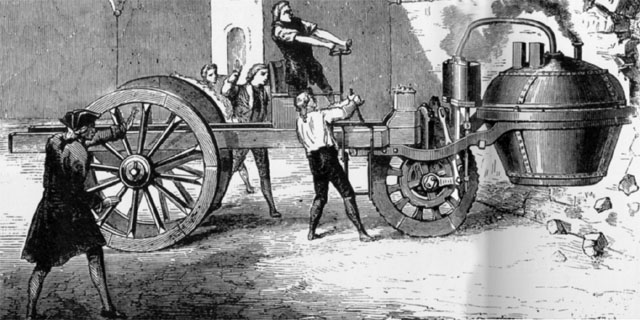
The first vehicle to move under its own power for which there is a record was designed by Nicholas Joseph Cugnot and constructed by M. Brezin in 1769. A replica of this vehicle is on display at the Conservatoire des Arts et Metiers, in Paris. I believe that the Smithsonian Museum in Washington D. C. also has a large (half size ?) scale model. A second unit was built in 1770 which weighed 8000 pounds and had a top speed on 2 miles per hour and on the cobble stone streets of Paris this was probably as fast as anyone wanted to go it. The picture shows the first model on its first drive around Paris were it hit and knocked down a stone wall. It also had a tendency to tip over frontward unless it was counterweighted with a canon in the rear. the purpose of the vehicle was to haul canons around town.
The early steam powered vehicles were so heavy that they were only practical on a perfectly flat surface as strong as iron. A road thus made out of iron rails became the norm for the next hundred and twenty five years. The vehicles got bigger and heavier and more powerful and as such they were eventually capable of pulling a train of many cars filled with freight and passengers.
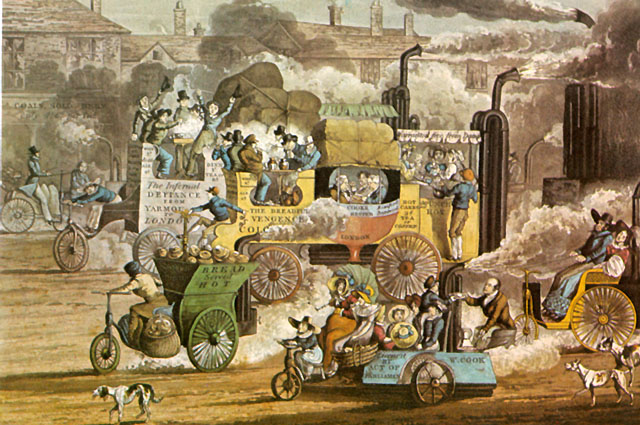
As the picture at the right shows, many attempts were being made in England by the 1830's to develop a practical vehicle that didn't need rails. A series of accidents and propaganda from the established railroads caused a flurry of restrictive legislation to be passed and the development of the automobile bypassed England. Several commercial vehicles were built but they were more like trains without tracks.
The development of the internal combustion engine had to wait until a fuel was available to combust internally. Gunpowder was tried but didn't work out. Gunpowder carburetors are still hard to find. The first gas really did use gas. They used coal gas generated by heating coal in a pressure vessel or boiler. A Frenchman named Etienne Lenoir patented the first practical gas engine in Paris in 1860 and drove a car based on the design from Paris to Joinville in 1862. His one-half horse power engine had a bore of 5 inches and a 24 inch stroke. It was big and heavy and turned 100 rpm. Lenoir died broke in 1900.
Lenoir had a separate mechanism to compress the gas before combustion. In 1862, Alphonse Bear de Rochas figured out how to compress the gas in the same cylinder in which it was to burn, which is the way we still do it. This process of bringing the gas into the cylinder, compressing it, combusting the compressed mixture, then exhausting it is know as the Otto cycle, or four cycle engine. Lenoir claimed to have run the car on benzene and his drawings show an electric spark ignition. If so, then his vehicle was the first to run on petroleum based fuel, or petrol, or what we call gas, short for gasoline.
Siegfried Marcus, of Mecklenburg, built a can in 1868 and showed one at the Vienna Exhibition of 1873. His later car was called the Strassenwagen had about 3/4 horse power at 500 rpm. It ran on crude wooden wheels with iron rims and stopped by pressing wooden blocks against the iron rims, but it had a clutch, a differential and a magneto ignition. One of the four cars which Marcus built is in the Vienna Technical Museum and can still be driven under its own power.
In 1876, Nokolaus Otto patented the Otto cycle engine, de Rochas had neglected to do so, and this later became the basis for Daimler and Benz breaking the Otto patent by claiming prior art from de Rochas.
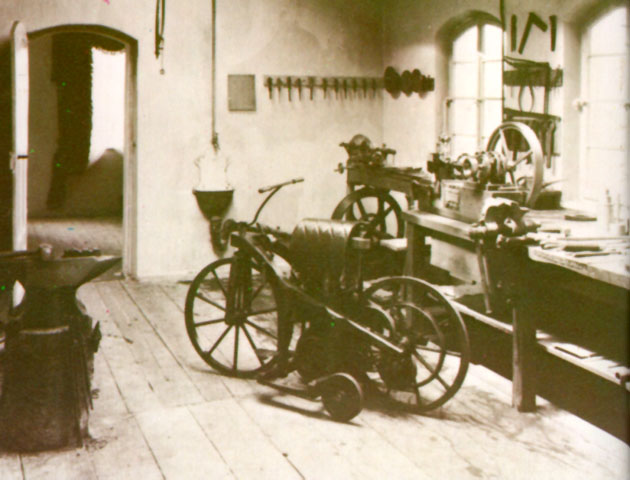
The picture to the left, taken in 1885, is of Gottllieb Daimler's workshop in Bad Cannstatt where he built the wooden motorcycle shown. Daimler's son Paul rode this motorcycle from Cannstatt to Unterturkheim and back on November 10, 1885. Daimler used a hot tube ignition system to get his engine speed up to 1000 rpm
The previous August, Karl Benz had already driven his light, tubular framed tricycle around the Neckar valley, only 60 miles from where Daimler lived and worked. They never met. Frau Berta Benz took Karl's car one night and made the first long car trip to see her mother, traveling 62 miles from Mannheim to Pforzheim in 1888.
Also in August 1888, William Steinway, owner of Steinway & Sons piano factory, talked to Daimler about US manufacturing right and by September had a deal. By 1891 the Daimler Motor Company, owned by Steinway, was producing petrol engines for tramway cars, carriages, quadricycles, fire engines and boats in a plant in Hartford, CT.
Steam cars had been built in America since before the Civil War but the early one were like miniature locomotives. In 1871, Dr. J. W. Carhart, professor of physics at Wisconsin State University, and the J. I. Case Company built a working steam car. It was practical enough to inspire the State of Wisconsin to offer a $10,000 prize to the winner of a 200 mile race in 1878.>
The 200 mile race had seven entries, or which two showed up for the race. One car was sponsored by the city of Green Bay and the other by the city of Oshkosh. The Green Bay car was the fastest but broke down and the Oshkosh car finished with an average speed of 6 mph.
From this time until the end of the century, nearly every community in America had a mad scientist working on a steam car. Many old news papers tell stories about the trials and failures of these would be inventors.
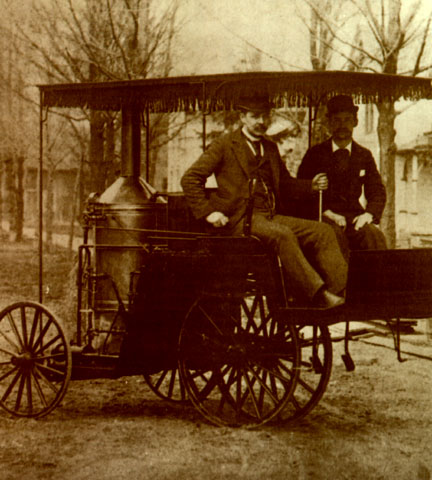
By 1890 Ransom E. Olds had built his second steam powered car, pictured at left. One was sold to a buyer in India, but the ship it was on was lost at sea.


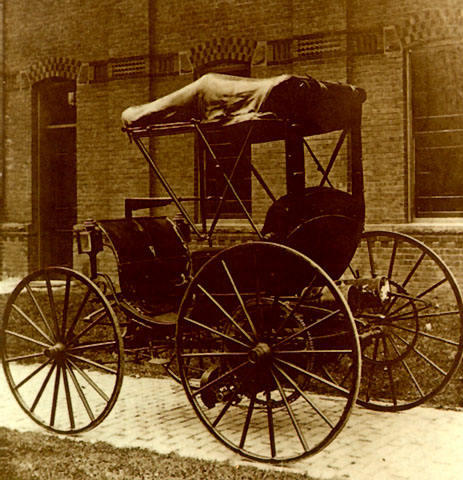
Running by February, 1893 and ready for road trials by September, 1893 the car built by Charles and Frank Duryea, brothers, was the first gasoline powered car in America. The first run on public roads was made on September 21, 1893 in Springfield, MA. They had purchased a used horse drawn buggy for $70 and installed a 4 HP, single cylinder gasoline engine. The car (buggy) had a friction transmission, spray carburetor and low tension ignition. It must not have run very well because Frank didn't drive it again until November 10 when it was reported by the Springfield Morning Union newspaper. This car was put into storage in 1894 and stayed there until 1920 when it was rescued by Inglis M. Uppercu and presented to the United States National Museum.

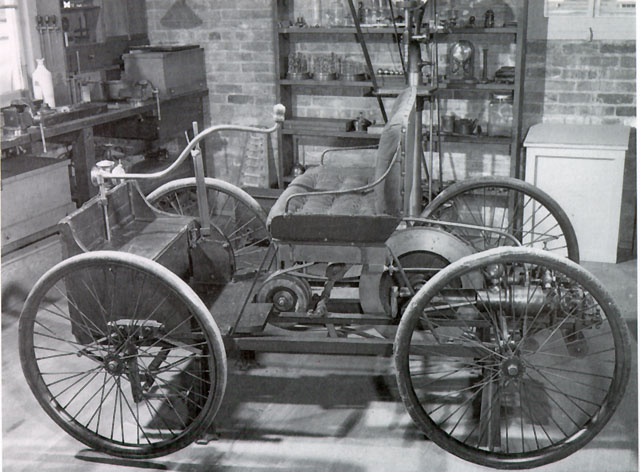
Henry Ford had an engine running by 1893 but it was 1896 before he built his first car. By the end of the year Ford had sold his first car, which he called a Quadracycle, for $200 and used the money to build another one. With the financial backing of the Mayor of Detroit, William C. Maybury and other wealthy Detroiters, Ford formed the Detroit Automobile Company in 1899. A few prototypes were built but no production cars were ever made by this company. It was dissolved in January 1901. Ford would not offer a car for sale until 1903.

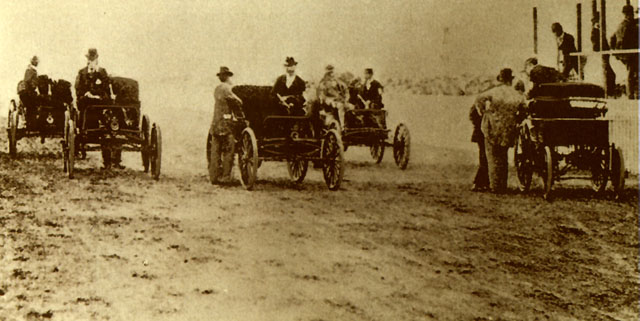
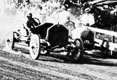
The first closed circuit automobile race held at Narragansett Park, Rhode Island, in September 1896. All four cars to the left are Duryeas, on the right is a Morris & Salom Electrobat. Thirteen Duryeas of the same design were produced in 1896, making it the first production car.

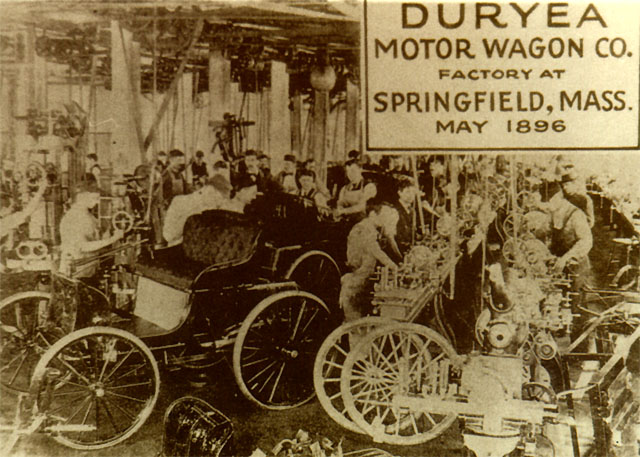
At left is pictured the factory with produced the 13 Duryeas. In 1898 the brothers went their separate ways and the Duryea Motor Wagon Company was closed. Charles, who was born in 1861 and was eight years older than Frank had taken advantage of Frank in publicity and patents. Frank went out on his own and eventually joined with Stevens Arms and Tool Company to form the Stevens-Duryea Company which was sold to Westinghouse in 1915. Charles tried to produce some of his own hare-brained ideas with various companies until 1916. Thereafter he limited himself to writing technical book and articles. He died in 1938. Frank got a half a million dollars for the Westinghouse deal and lived in comfort until his death in 1967, just seven months from his 98th birthday.
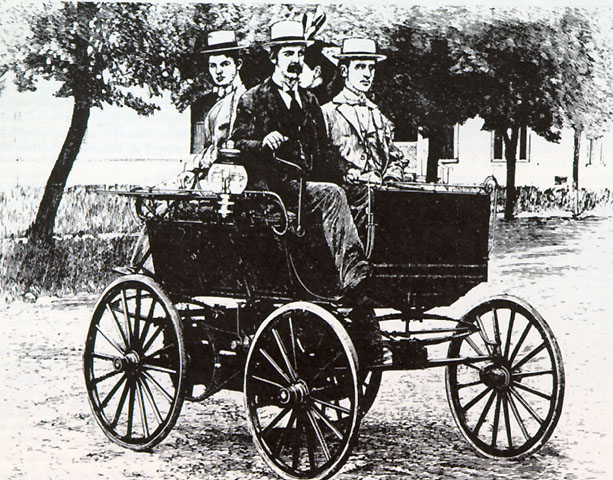
In this engraving Ransom Eli Olds is at the tiller of his first petrol powered car. Riding beside him is Frank G. Clark, who built the body and in the back are their wives. This car was running by 1896 but production of the Olds Motor Vehicle Company of Detroit did not begin until 1899. After an early failure with luxury vehicles they established the first really successful production with the classic Curved Dash Oldsmobile.

The Curved Dash Oldsmobile had a single cylinder engine, tiller steering and chain drive. It sold for $650. In 1901 600 were sold and the next years were 1902 - 2,500, 1903 - 4,000, 1904 - 5,000. In August 1904 Ransom Olds left the company to form Reo (for Ransom Eli Olds). Ransom E. Olds was the first mass producer of gasoline powered automobiles in the United States, even though Duryea was the first auto manufacturer with their 13 cars.

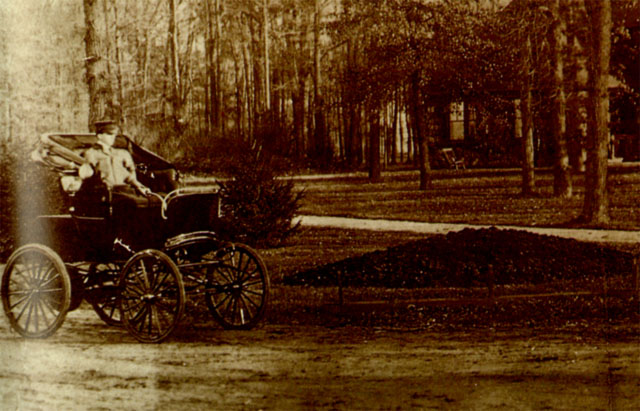
Ransom Olds produced a small number of electric cars around the turn of the century. Little is known about them and none survive. The picture at left is the only known picture of one of these rare cars. It was taken at was taken at Belle Island Park, Michigan. In 1899 and 1900, electrics outsold all other type of cars and the most popular electric was the Columbia built by Colonel Albert Augustus Pope, owner of American Bicycle Company.
an interesting footnote to the Olds electric.
J. A. Koosen and H. Lawson in a 1895 Lutzmann. This is typical of American design in the mid 1890's. It was truly a horseless carriage. Tiller steering, engine under the floorboards, very high center of gravity, not designed for road travel. Imagine climbing into one of these and trying to drive across town and around a few corners. Kind of scary, huh?
This Daimler of 1899 was owned by Lionel Rothchild. The European design is much advanced of the American designs of the same time. Gottlieb Daimler took part in the London-to-Brighton run in 1896 but died in 1900 at the age of 66 without ever meeting Benz. His German engines powered the automobile industries of Britain and France.
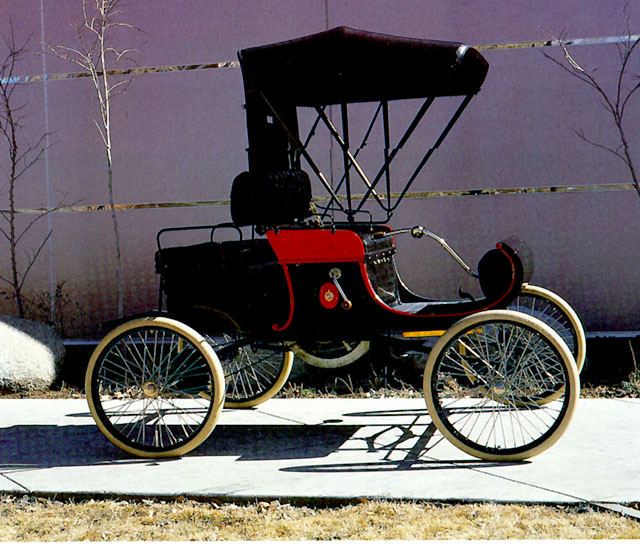
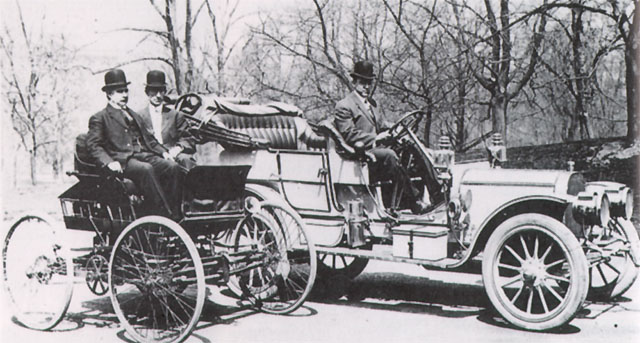
The 1908 Haynes in the back ground shows the rapid development of the petrol powered car when compared to the 1894 model in the foreground. Consider the present difference between a 1998 Tarus and the 14 year old 1984 Tarus. Some difference. Old man Haynes claimed to have build the 1894 car in 1893 but had no proof.
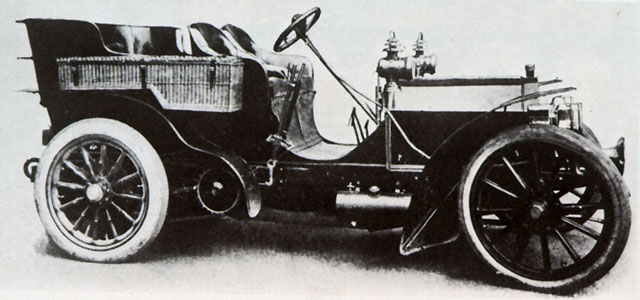
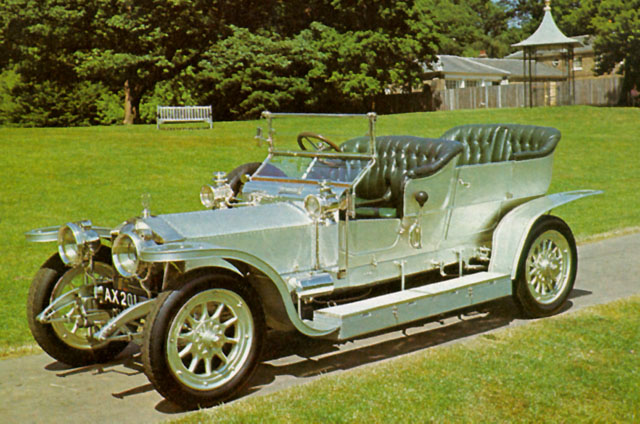
The Rolls Royce Silver Ghost of 1906 was a six cylinder car that stayed in production until 1925. It represented the best engineering and technology available at the time and these cars still run smoothly and silently today. This period marked the end of the beginning of the automobile.


How The Car Changed The County, Town by Town

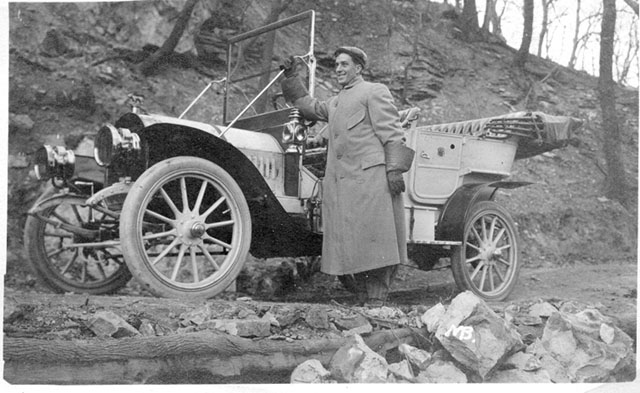
In 1903, in Winfield, Kansas Mr. H. T. Trice is seen standing in from of the first car in town. Acutally it was more like a truck and was used to haul customers out to see land. The railroads brought potential customers to town and Mr. Trice picked them up at the depot and took them out to his new developments.

Steam power was widely used in the 1880's and 1890's on the farms of America. Cowley County had its share of these behemoths and had a large group of people with the ability to use, and the skill to fix and repair them. The smaller, less expensive automobile, with an internal combustion engine provided a new avenue of interest that was much more personal than the steam engine with its team of attendants.

Mr. Martin Baden of Winfield, Kansas and his new eight-cylinder Cadillac roadster. This car was especially built for Mr. Baden, and was equipped with all modern appliances. Driving an automobile required a high degree to technical dexterity, mechanical skill, special clothing including hat, gloves, duster coat, goggles and boots. Tires were notoriously unreliable and changing one was an excruciating experience. Fuel was a problem, since gasoline was in short supply. Mr. Baden became interested enough to become a self-taught geologist and eventually discover major oil deposits in Cowley County, Kansas, and surrounding area.
The drivers of the day were an adventurous lot, going out in every kind of weather, unprotected by an enclosed body, or even a convertible top. Everyone in town knew who owned what car and the cars were soon to become each individuals token of identity. Notice the guy at the far right fixing his flat time. The dirt roads were a challenge in any weather. By 1910 Winfield paved the downtown streets with brick, horses were no longer welcome. The mule drawn trolleys were upgraded to electric streetcars.

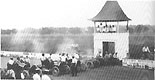
By 1915 racing had become a passion all over the United States. A typical local race track was at the Cowley County Fairgrounds in Winfield, Kansas. The local obsession with horse racing, started by the earliest settlers in 1870, turned to the new technology of auto racing. Local farm boys who were familiar with motors and equipment used their talents on cars and motorcycles to go faster than anyone in the county.

The horse racing facilities were quickly converted to the new, faster, more dangerous, and thus more exciting, motor racing. See Bob Lawrence's Home Page for new sections on both Auto Racing and Motorcycle Racing in Cowley County, Kansas

Eventually the automobile change the face of small town America. The town gentry bought cars, albiet fashoned to match their station in life. In Winfield, Kansas, Main Street went from a gathering place for people and horses and wagons to a parking place for the ubiquitous automobile. The Trolley Cars were displaced to make room for more cars. The brick streets were covered with asphalt to provide a smoother ride for the automobile. The old fire maps of Winfield show the inexorable spread of the automobile and all of the supporting businesses. Filling stations, auto dealers, battery stations, oil depots all grew and expanded to displace to older technologies of the day. R. B. Sandford's Winfield Carriage Works appears on the fire-map of Block 127 in 1918. But on the same spot on Block 127 in 1925 it has been replaced by a Battery Station and an Auto Storage facility.
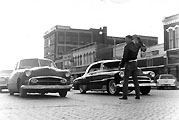
Midway through the century, cars had become a central feature of life for young people. The cars owned by the students of Winfield High School in the fifties are typical of every where in America at that time. It was mobility, status, challenge, and social freedom. It certainly hurt our football team at the time. A typical excuse for not playing on the football team was that a student had to work to earn money to pay for their car. When asked why they needed a car, the answer was invariably: to get to work!
After a century of the automobile, we can begin to assess the effects of long term transport by internal combustion. Nearly every aspect of our lives has developed around this technology. Only now, are we seeing new digital communications technologies, of the internet and beyond, that may eventually displace some of the functions of the automobile and replace our current problems with a new set that you, our grandchildren, will be charged with solving. Ask your grandparents about their first car. I'm sure you will get to hear a great story.

The First Generation Computers

Do you remember this computer?

Bendix G-15 Computer

It is the Bendix G-15 General Purpose Digital Computer, a First Generation computer introduced in 1956.

Another picture (66k). And another (105k). And you can download larger versions of the following pictures on this page by clicking on them. (But be aware, they vary in size between 0.5MB and 1.5MB and downloading will be slow).  Our G-15, front view  Our G-15, front view

Why this interest in the Bendix G-15?

Against the odds, the Western Australian branch of The Australian Computer Museum Inc has rescued one from the scrap heap. That's it, over on the right.
It is in pretty good condition, considering its age, and we hope one day we can get it working again. We also have various programming, operating and technical manuals, and schematics. They have been scanned and you can download them here.
This web site started life in 1998 as a sort of begging letter, seeking more information about the maintenance procedures. We have since been told that there was no formal maintenance manual and that our documentation is complete so far as maintaining the machine is concerned. Still, if you can help with some of the other items we are missing or add anything at all to our store of knowledge about the Bendix G-15, please get in touch with me, David Green at email address. StatCounter - Free Web Tracker and Counter

First Generation Computers.

The first generation of computers is said by some to have started in 1946 with ENIAC, the first 'computer' to use electronic valves (ie. vacuum tubes). Others would say it started in May 1949 with the introduction of EDSAC, the first stored program computer. Whichever, the distinguishing feature of the first generation computers was the use of electronic valves.
My personal take on this is that ENIAC was the World's first electronic calculator and that the era of the first generation computers began in 1946 because that was the year when people consciously set out to build stored program computers (many won't agree, and I don't intend to debate it). The first past the post, as it were, was the EDSAC in 1949. The period closed about 1958 with the introduction of transistors and the general adoption of ferrite core memories.
OECD figures indicate that by the end of 1958 about 2,500 first generation computers were installed world-wide. (Compare this with the number of PCs shipped world-wide in 1997, quoted as 82 million by Dataquest).
Two key events took place in the summer of 1946 at the Moore School of Electrical Engineering at the University of Pennsylvania. One was the completion of the ENIAC. The other was the delivery of a course of lectures on "The Theory and Techniques of Electronic Digital Computers". In particular, they described the need to store the instructions to manipulate data in the computer along with the data. The design features worked out by John von Neumann and his colleagues and described in these lectures laid the foundation for the development of the first generation of computers. That just left the technical problems!  Bendix G-15, side panel open  Bendix G-15, side panel open
One of the projects to commence in 1946 was the construction of the IAS computer at the Institute of Advanced Study at Princeton. The IAS computer used a random access electrostatic storage system and parallel binary arithmetic. It was very fast when compared with the delay line computers, with their sequential memories and serial arithmetic.
The Princeton group was liberal with information about their computer and before long many universities around the world were building their own, close copies. One of these was the SILLIAC at Sydney University in Australia.
I have written an emulator for SILLIAC. You can find it here, along with a link to a copy of the SILLIAC Programming Manual.

First Generation Technologies

In 1946 there was no 'best' way of storing instructions and data in a computer memory. There were four competing technologies for providing computer memory: electrostatic storage tubes, acoustic delay lines (mercury or nickel), magnetic drums (and disks?), and magnetic core storage.
A high-speed electrostatic store was the heart of several early computers, including the computer at the Institute for Advanced Studies in Princeton. Professor F. C. Williams and Dr. T. Kilburn, who invented this type of store, described it in Proc.I.E.E. 96, Pt.III, 40 (March, 1949). A simple account of the Williams tube is given here.
The great advantage of this type of "memory" is that, by suitably controlling the deflector plates of the cathode ray tube, it is possible to redirect the beam almost instantaneously to any part of the screen: random access memory.
Acoustic delay lines are based on the principle that electricity travels at the speed of light while mechanical vibrations travel at about the speed of sound. So data can be stored as a string of mechanical pulses circulating in a loop, through a delay line with its output connected electrically back to its input. Of course, converting electric pulses to mechanical pulses and back again uses up energy, and travel through the delay line distorts the pulses, so the output has to be amplified and reshaped before it is fed back to the start of the tube.  Bendix G-15, side panel and side door open  Bendix G-15, side panel and side door open
The sequence of bits flowing through the delay line is just a continuously repeating stream of pulses and spaces, so a separate source of regular clock pulses is needed to determine the boundaries between words in the stream and to regulate the use of the stream.
Delay lines have some obvious drawbacks. One is that the match between their length and the speed of the pulses is critical, yet both are dependent on temperature. This required precision engineering on the one hand and careful temperature control on the other. Another is a programming consideration. The data is available only at the instant it leaves the delay line. If it is not used then, it is not available again until all the other pulses have made their way through the line. This made for very entertaining programming!
A mercury delay line is a tube filled with mercury, with a piezo-electric crystal at each end. Piezo-electric crystals, such as quartz, have the special property that they expand or contract when the electrical voltage across the crystal faces is changed. Conversley, they generate a change in electrical voltage when they are deformed. So when a series of electrical pulses representing binary data is applied to the transmitting crystal at one end of the mercury tube, it is transformed into corresponding mechanical pressure waves. The waves travel through the mercury until they hit the receiving crystal at the far end of the tube, where the crystal transforms the mechanical vibrations back into the original electrical pulses.
Mercury delay lines had been developed for data storage in radar applications. Although far from ideal, they were an available form of computer memory around which a computer could be designed. Computers using mercury delay lines included the ACE computer developed at the National Physical Laboratory, Teddington, and its successor, the English Electric DEUCE.
A good deal of information about DEUCE (manuals, operating instructions, program and subroutine codes and so on) is available on the Web and you can find links to it here.
Nickel delay lines take the form of a nickel wire. Pulses of current representing bits of data are passed through a coil surrounding one end of the wire. They set up pulses of mechanical stress due to the 'magnetostrictive' effect. A receiving coil at the other end of the wire is used to convert these pressure waves back into electrical pulses. The Elliott 400 series, including the 401, 402, 403 used nickel delay lines. Much later, in 1966, the Olivetti Programma 101 desk top calculator also used nickel delay lines.  Bendix G-15, side door fully open  Bendix G-15, side door fully open
The magnetic drum is a more familiar technology, comparable with modern magnetic discs. It consisted of a non-magnetic cylinder coated with a magnetic material, and an array of read/write heads to provide a set of parallel tracks of data round the circumference of the cylinder as it rotated. Drums had the same program optimisation problem as delay lines.
Two of the most (commercially) successful computers of the time, the IBM 650 and the Bendix G-15, used magnetic drums as their main memory.
The Massachusetts Institute of Technology Whirlwind 1 was another early computer and building started in 1947. However, the most important contribution made by the MIT group was the development of the magnetic core memory, which they later installed in Whirlwind. The MIT group made their core memory designs available to the computer industry and core memories rapidly superceded the other three memory technologies.

Where Does the Bendix G-15 Fit In?

Table 1 shows, in chronological order between 1950 and 1958, the initial operating date of computing systems in the USA. This is not to suggest that all of these computers were first generation computers, or that no first generation computers were made after 1958. It does give a rough guide to the number of first generation computers made.
Bendix introduced their G-15 in 1956. It was not the first Bendix computing machine. They introduced a model named the D-12, in 1954. However, the D-12 was a digital differential analyser and not a general purpose computer.
We don't know when the last Bendix G-15 was built, but about three hundred of the computers were ultimately installed in the USA. Three found their way to Australia. The one we have was purchased by the Department of Main Roads in Perth in 1962. It was used in the design of the Mitchell Freeway, the main road connecting the Northern suburbs to the city.
The G-15 was superceded by the second generation (transistorised) Bendix G-20.
Table 2 shows the computers installed or on order, in Australia, about December 1962. The three Bendix G-15s were in Perth (Department of Main Roads), Sydney (A.W.A. Service Bureau) and Melbourne (E.D.P Pty Ltd). Close-up of packages in situ Close-up of packages in situ

Overview of the G-15

The Bendix G-15 was a fairly sophisticated, medium size computer for its day. It used a magnetic drum for internal memory storage and had 180 tube packages and 300 germanium diode packages for logical circuitry. Cooling was by internal forced air.
Storage on the Magnetic Drum comprised 2160 words in twenty channels of 108 words each. Average access time was 4.5 milliseconds. In addition, there were 16 words of fast-access storage in four channels of 4 words each, with average access time of 0.54 milliseconds; and eight words in registers consisting of 1 one-word command register, 1 one-word arithmetic register, and 3 two-word arithmetic registers for double-precision operations.
A 108-word buffer channel on the magnetic drum allowed input-output to proceed simultaneously with computation.
Word size was 29 bits, allowing single-precision numbers of seven decimal digits plus sign during input-output and twenty nine binary digits internally, and double-precision numbers of fourteen decimal digits plus sign during input-output, fifty eight binary digits internally.
Each machine language instruction specified the address of the operand and the address of the next instruction. Double-length arithmetic registers permitted the programming of double-precision operations with the same ease as single-precision ones. A CA155 valve package A CA155 valve package
An interpreter called Intercom 1000 and a compiler called Algo provided simpler alternatives to machine language programming. Algo followed the principles set forth in the international algorithmic language, Algol, and permitted the programmer to state a problem in algebraic form. The Bendix Corporation claimed to be the first manufacturer to introduce a programming system patterned on Algol.
The basic computation times, in milliseconds, were as follows (including the time required for the computer to read the command prior to its execution). The time range for multiplication and division represents the range between single decimal digit precision and maximum precision.
 
Single-Precision Double-Precision

Addition or Subtraction 0.54 0.81

Multiplication or Division 2.43 to 16.7 2.43 to 33.1
External Storage was provided on searchable paper tape (2,500 words per magazine) and, optionally, on one to four, magnetic tape units with 300,000 words per tape unit reel. 

An Illustrated History of Computers

John Kopplin © 2002

The first computers were people! That is, electronic computers (and the earlier mechanical computers) were given this name because they performed the work that had previously been assigned to people. "Computer" was originally a job title: it was used to describe those human beings (predominantly women) whose job it was to perform the repetitive calculations required to compute such things as navigational tables, tide charts, and planetary positions for astronomical almanacs. Imagine you had a job where hour after hour, day after day, you were to do nothing but compute multiplications. Boredom would quickly set in, leading to carelessness, leading to mistakes. And even on your best days you wouldn't be producing answers very fast. Therefore, inventors have been searching for hundreds of years for a way to mechanize (that is, find a mechanism that can perform) this task.
This picture shows what were known as "counting tables" [photo courtesy IBM]
A typical computer operation back when computers were people.
The abacus was an early aid for mathematical computations. Its only value is that it aids the memory of the human performing the calculation. A skilled abacus operator can work on addition and subtraction problems at the speed of a person equipped with a hand calculator (multiplication and division are slower). The abacus is often wrongly attributed to China. In fact, the oldest surviving abacus was used in 300 B.C. by the Babylonians. The abacus is still in use today, principally in the far east. A modern abacus consists of rings that slide over rods, but the older one pictured below dates from the time when pebbles were used for counting (the word "calculus" comes from the Latin word for pebble).
A very old abacus
A more modern abacus. Note how the abacus is really just a representation of the human fingers: the 5 lower rings on each rod represent the 5 fingers and the 2 upper rings represent the 2 hands.
In 1617 an eccentric (some say mad) Scotsman named John Napier invented logarithms, which are a technology that allows multiplication to be performed via addition. The magic ingredient is the logarithm of each operand, which was originally obtained from a printed table. But Napier also invented an alternative to tables, where the logarithm values were carved on ivory sticks which are now called Napier's Bones.
An original set of Napier's Bones [photo courtesy IBM]
A more modern set of Napier's Bones
Napier's invention led directly to the slide rule, first built in England in 1632 and still in use in the 1960's by the NASA engineers of the Mercury, Gemini, and Apollo programs which landed men on the moon.
A slide rule
Leonardo da Vinci (1452-1519) made drawings of gear-driven calculating machines but apparently never built any.
A Leonardo da Vinci drawing showing gears arranged for computing
The first gear-driven calculating machine to actually be built was probably the calculating clock, so named by its inventor, the German professor Wilhelm Schickard in 1623. This device got little publicity because Schickard died soon afterward in the bubonic plague.
Schickard's Calculating Clock
In 1642 Blaise Pascal, at age 19, invented the Pascaline as an aid for his father who was a tax collector. Pascal built 50 of this gear-driven one-function calculator (it could only add) but couldn't sell many because of their exorbitant cost and because they really weren't that accurate (at that time it was not possible to fabricate gears with the required precision). Up until the present age when car dashboards went digital, the odometer portion of a car's speedometer used the very same mechanism as the Pascaline to increment the next wheel after each full revolution of the prior wheel. Pascal was a child prodigy. At the age of 12, he was discovered doing his version of Euclid's thirty-second proposition on the kitchen floor. Pascal went on to invent probability theory, the hydraulic press, and the syringe. Shown below is an 8 digit version of the Pascaline, and two views of a 6 digit version:
Pascal's Pascaline [photo © 2002 IEEE]
A 6 digit model for those who couldn't afford the 8 digit model
A Pascaline opened up so you can observe the gears and cylinders which rotated to display the numerical result
Click on the "Next" hyperlink below to read about the punched card system that was developed for looms for later applied to the U.S. census and then to computers... 

What is the computer ?

computer

A programmable machine. The two principal characteristics of a computer are:

  • It responds to a specific set of instructions in a well-defined manner.

  • Modern computers are electronic and digital. The actual machinery -- wires, transistors, and circuits -- is called hardware; the instructions and data are called software.
    All general-purpose computers require the following hardware components:

  • memory : Enables a computer to store, at least temporarily, data and programs.

  • mass storage device : Allows a computer to permanently retain large amounts of data. Common mass storage devices include disk drives and tape drives.

  • input device : Usually a keyboard and mouse, the input device is the conduit through which data and instructions enter a computer.

  • output device : A display screen, printer, or other device that lets you see what the computer has accomplished.

  • central processing unit (CPU): The heart of the computer, this is the component that actually executes instructions.

  • In addition to these components, many others make it possible for the basic components to work together efficiently. For example, every computer requires a bus that transmits data from one part of the computer to another.
    Computers can be generally classified by size and power as follows, though there is considerable overlap:

  • personal computer : A small, single-user computer based on a microprocessor. In addition to the microprocessor, a personal computer has a keyboard for entering data, a monitor for displaying information, and a storage device for saving data.

  • workstation : A powerful, single-user computer. A workstation is like a personal computer, but it has a more powerful microprocessor and a higher-quality monitor.

  • minicomputer : A multi-user computer capable of supporting from 10 to hundreds of users simultaneously.

  • mainframe : A powerful multi-user computer capable of supporting many hundreds or thousands of users simultaneously.

  • supercomputer : An extremely fast computer that can perform hundreds of millions of instructions per second.

  • Also see the The Five Generations of Computers and the Computer Science category in the Did You Know...? section of Webopedia

    Computer row sparks detention centre brawl

    A fight over computer access sparked a brawl at a Melbourne detention centre after almost 100 unaccompanied Afghani minors were transferred there over the weekend.
    About 50 teenagers were involved in Sunday night's brawl, which broke out in a common room at the Melbourne Immigration Transit Accommodation facility in the outer-west suburb of Broadmeadows.
    There were a number of separate scuffles in the dining room, an immigration department spokesman said.
    Seven of the boys, aged about 15-18, were taken to hospital suffering cuts and bruises, with one remaining there overnight.
    Furniture and windows were broken with police helping to restore order after about 30 minutes when the boys returned to their rooms, the spokesman said.
    Labor MP Maria Vamvakinou, whose federal seat of Calwell takes in Broadmeadows, said the brawl was disappointing but not a massive setback to the facility's expansion.
    The brawl between new and old detainees was sparked by a fight over computer access, after 98 unaccompanied Afghan minors were transferred to the centre from the Christmas Island detention centre over the weekend.
    They added to the 38 unaccompanied boys already there.
    The transfer was the first instalment of Immigration Minister Chris Bowen's September plan to expand the Melbourne centre, along with two others in Western Australia and Queensland, to cope with Australia's increased number of detained asylum seekers.
    Ms Vamvakinou was told the centre had not had time to wire up extra computers for the new arrivals.
    But she did not think the expansion had been rushed and she had seen adequate living and common quarters set up for the new arrivals. Portable buildings have also been erected over the last 10 weeks.
    "The idea is to get people accommodated physically and I think in that sense it was ready, perhaps this other IT stuff might have been a secondary issue, but I don't think it was rushed," Ms Vamvakinou said.
    The Broadmeadows centre was set up several years ago as a low security immigration facility to accommodate families on a short-stay basis.
    However Ms Vamvakinou said all 136 detainees at the centre were now boys without their families, aged 14-18.
    Despite long-standing community opposition to a detention centre, Ms Vamvakinou said locals had been working hard to make the centre a positive place.
    She said 120 boys from Melbourne schools regularly played soccer with the detainees, other community groups also visited and the boys were taken to and from school to learn English.
    "There is a lot of goodwill, we hope that in the coming months to increase community interaction, which I think is really important," Ms Vamvakinou told AAP.
    "I don't see it as a massive setback, but certainly, I'm not silly, I can see the headlines."
    Greens immigration spokeswoman Sarah Hanson-Young said mandatory detention created an unsafe environment for detainees, especially unaccompanied minors.
    "We know that when people are detained for long periods of time tensions rise," she told reporters in Canberra.
    "We really need to ensure that there is a better system."

    First Apple computer, the Apple-I, could fetch $242K at auction

    More than 34 years ago, in July of 1976, a small California company called Apple released its first computer. The Apple-I, which was designed and built by Apple co-founder Steve Wozniak, featured 4KB of memory, and a fully-functioning circuit board. According to one source, Wozniak originally wanted to charge $777.77 for the machine, but his partner, Steve Jobs, convinced him to drop the price tag to $666.66. Wozniak complied. 
    The rest – from the early Macintosh desktops to the top-of-the-line MacBook Airs, which pack as much punch in their pinkies as the Apple-I did in its entire body – is history. And now you can get a piece of that history. Later this month, the auction house Christie's will put a vintage Apple-I on the block, complete with a "few slightly later additions." Among the "additions," according to Christie's:
    A 6502 microprocessor, labeled R6502P R6502-11 8145, printed circuit board with 4 rows A-D and columns 1-18, three capacitors, heatsink, cassette board connector, 8K bytes of RAM, keyboard interface, firmware in PROMS, low-profile sockets on all integrated circuits, video terminal, breadboard area with slightly later connector, with later soldering, wires and electrical tape to reverse, printed to obverse Apple Computer 1 Palo Alto. Ca. Copyright 1976.
    Christie's has posted an estimate of $160,300 to $240,450 – which means you purchase half a warehouse full of MacBook computers for the same price as an Apple-I. So will the machine actually go for the estimated price? Hard to say. Previous Apple machines have fetched far less hefty sums – but then again, Apple mania has surged in the past year or so, and the Apple-I would be a great prize for the right collector.
    After all, there were only 200 Apple-I units produced, according to eWeek – not exactly a gigantic run.

    Weaponized Printers?

    By Sean Doherty

    DoubleSided: Bombs Found in Printer Cartridges en Route to the U.S.
    DBZ-86-DS-500
    You may have been horrified when we reported on the Australian couple that discovered a snake in their printer. Recently, the news revealed yet a new danger lurking in printers: bombs.
    In October, authorities in England and in the United Arab Emirates intercepted printers (en route to Chicago from Yemen) that included bombs wired to cell phones hidden in the toner cartridges. The cell phones were rigged to trigger the alarm or timer functions to detonate the bombs, which each contained 300 and 400 grams of PETN, an industrial explosive.
    The bombs were hidden so well that at first bomb experts failed to locate the danger, even when sniffer dogs assisted the investigation. Fortunately, forensic experts took a second look.
    If you are at all worried about discovering a bomb in your next printer cartridge, rest assured that officials have put new security rules in place banning all cargo from Yemen and Somalia and prohibiting toner and ink cartridges weighing more than one pound from passenger flights. European Union ministers are in discussion to ban cargo security from airports with inadequate security measures.
    Here's hoping your printer goes vroom when you send it a print job — and not boom.
    About DoubleSided
    We all have our idiosyncrasies. So do printers as it turns out. In our DoubleSided feature, we explore the lighter side of printers as well as the esoteric and bizarre. We also peer into the future of printing. From fabbers to printing on toast, you'll find it all here.

    Five Printer Nightmares and How to Avoid Them

    The printer ate your TPS reports, but no excuse matters when you're rushing off to meet clients empty-handed. No wonder everybody loves to hate printers. When you need them most, they'll display a stupefying error message and create a hot mess of jammed paper and spilled ink.
    The printer ate your TPS reports, but no excuse matters when you're rushing off to meet clients empty-handed. No wonder everybody loves to hate printers. When you need them most, they'll display a stupefying error message and create a hot mess of jammed paper and spilled ink.
    But before you pick up a baseball bat to express your printer rage, take a deep breath. With some patience and attention, you can probably overcome the printer problem that vexes you--and avoid having the nightmare recur in the future. Here's how to address five of the most common printer complaints.
    1. Paper Jams
    Printer jams occur when the paper feeding through the printer goes awry. Sometimes the printer ignores the problem, soldiers onward, and extrudes a crumpled mess into the output tray; on other occasions, the printer stops in midjob, and the crumpled mess--or part of it--remains trapped somewhere inside the machine.
    When a paper jam occurs, some printers flash lights at you and scream for help. Others sense where the jam is and provide guidance on clearing the blockage. If your printer offers diagnostic advice, follow it. Also, take time to check the printer's documentation for help in clearing jams. Here are the basic steps you'll follow to correct the problem:
    Turn off the printer. If you're going to be working inside the printer, you don't want any trouble with electricity or moving parts. And if you're dealing with a laser printer, you also don't want the fuser to generate additional heat. If the paper is jammed in or near the fuser unit (you'll feel the heat as you come near it), you'll have to wait for the fuser to cool off before clearing the jam.
    Open all doors leading to the paper path. If you can't tell which door leads to the paper jam, start by removing or opening the input tray and following the paper path all the way to the output tray, opening every door or panel that you can find along the way.
    Carefully pull out paper sheets and scraps. Check for paper sheets that are stuck or askew, as well as for paper scraps. Pull paper out of the path firmly but very carefully and slowly. When possible, pull paper in the direction it is supposed to go in under normal conditions--not backward, which could strain the printer's mechanics.Take care to remove all of the paper: As any scraps that remain could cause further jamming. If you have the misfortune of breaking a mechanical piece in the printer, stop what you're doing and call for service.
    Close all doors and turn on the printer. Once switched on, the printer should reset itself automatically. If the printer reports that it is still jammed, double-check for stray paper scraps, and then close all the doors again. If the printer continues to complain, try turning it off and then back on. If the complaints continue, you'll have to call for service--and hope that a deep-seated piece of paper--rather than a broken mechanical part--is the source of the problem.
    How do I avoid this next time? As in most relationships, good communication and kind treatment will help your interaction with your printer go smoothly. Use only one kind of paper at a time in your input tray. Whether you have a single input tray in your printer's driver or many input trays, tell the printer what kind of paper you have in the tray: Most printer controls include a section or drop-down list where you can pick a paper by name, type, thickness, or other quality. If you aren't sure whether your printer takes a certain kind of paper, check its documentation. When you reload your input tray, pay attention to the tray's needs, such as how the paper should be loaded and whether the length or width guides need adjusting.
    2. Stuck in the Print Queue
    Regardless of how sophisticated it is, a printer can print only one job at a time. Sometimes a job will get held up for some reason and block every job behind it. If you've confirmed that the printer hasn't stalled for a mechanical reason, such as a jam or a lack of paper, toner, or ink, check the print queue to see whether a specific job in front of yours might be the culprit.
    If your printer is not networked: If your computer has a dedicated printer associated with it, you can get to the print queue directly. On Windows, access is through the Control Panel's Printers program item; on a Mac, it's through the Utilities' Print & Fax program item. Any stuck jobs will be listed there, and you can easily cancel them.
    If your printer is on a network: On a networked queue, you have control only over the jobs that you send from your own PC. If another person's job is the problem, you must either contact them for help or ask your IS department to intervene.
    How do I avoid this next time? If the print queue clogs up regularly, your IT staff needs to figure out why it's happening and then address the root cause. Common problems include trying to print a job whose file size is so large that it chokes the network or your printer's memory; trying to print to a special kind of paper--such as letterhead--without loading the paper or specifying the tray in which it's loaded; and requesting a print job that requires you (or some other user) to feed the paper manually, but failing to perform this step.
    3. Spilled Toner or Ink
    Printer toner and ink are formulated to spread, adhere, and last--but that's supposed to happen on paper, not on the floor.
    Set the Right Toner
    Toner can spill inside the printer during regular use, or it can spill onto surfaces, clothing, skin, or carpets when you're replacing a cartridge.
    Basic Precautions
    • Keep spilled toner dry and contained.
    • Do not use hot water, cold water, or heat for cleanup; use any general cleaning solution with caution.
    • Do not use a conventional household vacuum cleaner, as it might blow the toner out the back.
    • Avoid inhaling the toner.
    Three Basic Ways to Remove Spilled Toner
    • For spills on hard, smooth surfaces, you can use a disposable sweeping device (cardboard, paper or envelope, paper towel) to sweep the toner carefully into a plastic bag or other sealable receptacle for disposal.
    • Special toner-cleaning cloths use static to attract the toner for easy wiping. Regular paper towels or cotton towels will also work adequately.
    • A special toner vacuum is the only kind of vacuum you should consider using. It has attachments designed to reach into small spaces and to pull toner from the interior of a printer or from an unlucky area of carpet, along with a receptacle designed to trap very small particles.
    How do I avoid this next time? Handle toner cartridges carefully, especially during insertion and removal. Before working with toner cartridges, protect surrounding areas from spills by covering them with newsprint or paper towels.
    Don't Cry Over Spilled Ink
    It's unusual for ink to spill from a cartridge unless the cartridge has been punctured, cracked, squeezed, or crushed. A refilled cartridge may be more susceptible to leaking or spilling; handle it carefully.
    Online advice about cleaning up printer ink spills recommends using substances ranging from rubbing alcohol to WD-40 to hairspray to bleach. The effectiveness of these nostrums will depend on where the ink landed, as well as on the ink's chemical content.
    A common-sense approach would be to handle spills quickly yet cautiously, starting with basic cleaning procedures and escalating as necessity dictates. Before applying any cleaning substance over a large area, test it to ensure that it doesn't cause damage of its own.
    First step in all cases: Blot spilled ink with an absorbent cloth or paper towel.
    Ink on skin: Use soap and water to clean further. If ink remains (and it probably will) try scrubbing. Use additional solutions on your skin cautiously--and at your own discretion.
    Ink on fabric or carpet: With soap and water, brush the stain using an upward-inward motion--upward so as not to push the ink deeper into the fabric, and inward so as not to spread the stain across a wider area. Use additional cleaning solutions with caution.
    Ink on hard surfaces: If a stain remains after blotting, try another method or cleaner that is appropriate to the particular surface.
    Ink in the printer: This is a messy job, and the outcome of your efforts is uncertain.
    • First, turn off the printer, if you can. If the printer offers access the cartridges only when it is on, keep it on for now. Check the ink cartridges. If the offending ink cartridge is still in the printer, you must decide whether the spill is likely to be worse if you leave the cartridge where it is or if you remove it. Do whatever you can to minimize further spillage while you clean.
    • Turn off the printer now if you haven't already done so, access its interior, and find and remove as much spillage as you can through blotting. Then use rubbing alcohol and lint-free cloths to clean further, taking care not to get anything stuck in the printer.
    • Run a test page and check for evidence of leftover ink, such as splotches or continuous streaks on the page. Observe the printer as it operates to ensure that it is acting normally again.
    • If you're lucky, everything will be fine after you run pages through the printer so the spilled ink can print itself out. If you're unlucky, ink that you couldn't remove will lead to further damage.
    How do I avoid this next time? Handle ink cartridges carefully, especially if they're refills, and especially during insertion and removal. If you're spill-prone, use newspaper or paper towels to protect the surrounding area.
    4. Power Loss in the Middle of a Print Job
    If this ever happens to you, you can treat it as if it were a special kind of paper jam.
    Turn off the printer. You don't want its parts to start churning unexpectedly while you're working on recovery.
    Clear the paper path. Remove any paper that's stuck in midprint.
    Turn on the printer (assuming that power to the machine is restored). As the printer initializes, check for error messages or odd noises that might indicate a malfunction or internal damage. If you have a laser or LED printer, check the documentation for a maintenance routine you can use to clean untransferred toner from the drum. An inkjet cartridge that stopped in midsquirt may require cleaning. Run a test page and check the output for stains, streaks, and other abnormalities. Consult your printer's documentation for further troubleshooting guidance.
    How do I avoid this next time? The odds that a printer will turn off on its own are low. If power outages are relatively frequent in your area, plug your printer into a UPS device so that it can finish printing and power down normally the next time the electricity fails.
    5. Printing on the Wrong Side of Photo Paper
    You wait eagerly for your photo to come out of the printer, but what you get is big splotches of ink sitting--and not drying--on the wrong side of the photo paper.
    Cancel the print job if you can. This is especially important your print job calls for printing multiple sheets of photos, as each wrong-way sheet will just add to the mess.
    Remove the paper carefully, making sure that the ink doesn't run. Avoid getting it on your hands by wearing gloves or by using a napkin or paper towel to handle the paper.
    Throw the whole thing away. Yes, you'll have to say goodbye to that expensive piece of paper and all that costly ink.
    How do I avoid this next time? Check the printer's documentation and tray markings to make certain that you are inserting the photo paper correctly.

    The printed book is not dead yet

    The relentless rise of the ebook is turning me into a resentful luddite. I want to snatch that smugly tiny ereader from the woman reading in bed in the Sony advert, and give her a doorstop of a hardback that will make her arms ache. As for that trendy young couple reading on the beach in the Amazon commercial, I want to kick sand in their third-generation Kindles until they have stopped working.
    My dislike of the ebook is partly motivated by selfishness: as an author I would like my words to end up in some concrete, permanent receptacle, not an erasable computer file that the reader does not even properly own. But mostly it is motivated by irritation at the orthodoxy – typified by Amazon's widely publicised announcement this summer that its American ebook sales had overtaken those of its hardbacks – that there is an irresistible momentum in favour of digital downloads and the days of the printed book are numbered.
    In search of counter-evidence, I turn to the experience of the most luddite author of the last century: George Mackay Brown, the reclusive Orkney poet who regarded the industrial revolution as a terrible wrong turning, warned against our worship of the "synthetic goddess" of progress, and used his column in the local newspaper to moan about voguish inventions such as transistor radios and telephones.
    "What brisk hard-headed commonsense dehydrated little manikins we are nowadays," he admonished his fellow Orcadians in 1955, "strutting around with our chequebooks!" He reserved his most caustic comments for television, which finally arrived on Orkney in the mid-1950s and which he feared would deliver a death blow to the already endangered activities of reading and communal storytelling.
    Time passed, and television found its place on Orkney. It became a mild addiction, which weakened but did not come close to destroying the art of pub storytelling or the pleasures of the printed word.
    In his later years, Mackay Brown reluctantly gave "half a genuflection" to the goddess of progress. He belatedly acquired a black-and-white TV, a telephone, a fridge and a digital watch, becoming fascinated by its "dance of dark numbers". He even listed watching TV as one of his recreations in Who's Who, alongside reading, while he carried on writing in longhand about 12th-century Orcadian sagas.
    I believe that Mackay Brown represents, in extreme form, how many of us late adopters respond to new technology. As David Edgerton, the historian of technology, argues, our understanding of historical progress tends to be "innovation-centric" rather than "use-centred". We obsess about exciting inventions and underestimate how much they will have to struggle against the forces of habit and inertia in our daily lives.
    Old-fashioned but serviceable technologies often prove surprisingly resilient. There was much amusement last year when the expenses scandal revealed that the former MP Chris Mullin, the Mackay Brown of Westminster, still had a black and white television set – yet, according to the most recent count, more than 28,000 other households also still have monochrome licences.
    A few decades ago we thought radio a dying form, but it is thriving in the age of new media. Listeners remain emotionally attached to their analogue radios and a recent report from the Department for Culture, Media and Sport recommended that the switch-off of the FM signal be delayed, possibly indefinitely.
    The valedictories for what is now disdainfully called "dead tree publishing" may be similarly premature. The lessons from history are that technological progress is uneven, that consumers are often sceptical of techno-hype, and that new technologies do not supplant old ones in linear fashion. Look at the iPad's ebook reader: your book purchase is stored on a real-looking wooden bookcase and you take it off the shelf and flip its virtual pages over with your fingers. Why, it's exactly like … reading a book! So long as the ebook continues to pay it the compliment of mimicry, I suspect that the printed book need not fear for its life just yet.

    See How Your New Print Will Look on Your Wall With Imagu iPhone App


    It hasn’t happened to me with art so much, but it’s definitely happened with furniture.  You know how it goes:  you pick out something that you think will look awesome, and then you get it into that mess you call your house, and “Man, I never thought it was going to look like that!”  Oops!
    Imagu wants to spare you the pain.  You totally lovin’ that Monet print you just saw, but are not sure how it will go with your Goodwill sofa that you covered up with that purple crocheted blanket you threw over it?  Imagu can help, baby!
    Imagu’s new iPhone app gives you access to over 50,000 art prints, and lets you use your iPhone camera so you can see how it’ll look on your wall.  That should help you avoid the embarrassing situation of, “I thought it was a light rose color, not pink!”  Available for free on iTunes.
    Full information below.
    Imagiu (http://imagiu.com) has partnered with Easyart.com, the UK’s number one online art print store, to launch it’s first application. The Easyart iPhone App provides a fun and interactive way to browse and buy over 50,000 art prints. By using the built in camera on the iPhone, the customer can also see the art on their own wall before they purchase.
    Easyart, a leader in building and running successful e-commerce websites, chose Imagiu as their partner because they knew that to be successful with this new retail channel they needed the expertise and understanding of how to best utilize the new device:
    “We chose to partner with Imagiu whose expertise in visualization technology on mobile devices has ensured an exciting mobile experience.  We couldn’t have managed to do it in-house, the skill set is just too different. ” Marc Lickfett, Managing Director at Easyart.com
    The iPhone app is the first in a suite of applications from Imagiu, aimed at increasing customer conversion and brand awareness for retailers in the home décor industry. Allowing customers to visualize their purchases in their own home as well as discuss and share the images with their social network to get feedback, increases confidence in their purchase. In addition, with the focus on mobile and tablet devices, Imagiu’s solutions provide fun and appealing ways for consumers to interact with the retailers’ products while on the go, increasing brand awareness and loyalty.
    “Providing retailers with fun and engaging ways to allow their customers to visualize and interact with their products thereby increasing conversions and brand awareness, is what Imagiu is all about. The visually rich, highly interactive and mobile capabilities of smartphone and tablet devices, make them the perfect platforms to realize our vision” Josh Guedalia, CEO , Imagiu
    Imagiu – The Future of Catalogues:
    The traditional paper mail order catalogue has lost out to the internet over the last 10 years, but still remains a major driver of revenue for some companies and products. The beauty of the old-fashioned catalogue is its’ portability, the simple user experience and independence of cables and wireless internet networks.
    Smartphone and tablet devices have similar qualities to the traditional catalogues in terms of portability, but provide a far greater element of fun, interactivity and visualization, with hassle-free access to content which gives them an edge over PCs and laptops. Imagiu’s products are taking the lead in replacing the outdated and environmentally questionable business of catalogue printing, heralding a new era of catalogues and
    mobile commerce.
    “Smartphones and tablets are as mobile as printed catalogues, but the user experience is far more interactive and customized. Touch screens, rich graphics, internet connectivity and multi-media capabilities make it possible to create really unique functionality that engages the customer and increases customer confidence, while showcasing the products. With the added elements of visualization that Imagiu brings, the overall experience is so much more useful and fun than thumbing through a paper catalogue – it moves the catalogue concept light years ahead. ” Mark Faber, VP Marketing, Imagiu
    Imagiu’s iPhone App for Easyart can be downloaded from the App Store free of charge. In addition to being able to view art on their own wall, users can email content to others or post it to Facebook as well as purchase the art from the phone through an iPhone optimized shopping cart.

    How To Make A Printer Wireless

    So you have yourself a wireless network and a printer. The printer is not wireless. The challenge is that you would like to print over the wireless network from any computer connected to your network either wired or wirelessly. How do do it?
    The answer is quite simple and the logic behind it is quite sound. No matter what the make or model the printer is, you can simply send print jobs to it through the wireless network by connecting it to a computer that is always on and share the printer from that machine.

    I will be using good old Windows XP as the client and print server to show you how it works. It will be a little more complicated on Windows 7 or Vista but if you have your share permissions down, it should be easy.
    First things first. Make sure that you have the same username and password set up on the machine you want to use as your print server and the machine you are going to print from. This is required so that you can communicate with the other machine. Once you have the machines’ usernames and passwords synced up, you can turn to the machine with the printer attached to it.
    From this machine (which we will call the print server), we will need to set up the printer on it (if it is not already completed). Test that you can print and the output is what you expected. Then we will need to go to Printers and Faxes in the control panel.
    how do i make my printer wireless
    You need to right click on the printer that you want to share and choose properties like so:
    how do i make my printer wireless
    When you get to the properties page for the printer, you will want to click on the tab that says Sharing. Chances are sharing will be turned off like it is in the screenshot below. Simply click on the share this printer button. That will enable the box to type in the printer’s name. It will be grayed out until you click the radio button to share it.
    how do i make my printer wireless
    You will want to name the printer something memorable. I called mine HP1100 (this was the default the machine offered me)
    wireless printer
    Now depending on what other operating systems that may connect to the print server, you might want to click the Additional drivers button to load up drivers for other operating systems besides Windows XP.
    wireless printer
    That will take you to this screen:
    wireless connection printer
    Simply check off the system types you want to use and point it to the correct drivers. You may have to find the CD that came with the printer or go download them from the manufacture’s site.
    Now, when you are done walk on over to the computer you want to print from wirelessly. Hit Start – run and then type \\ and your IP address or host name. Mine is 192.168.1.29 so I typed \\192.168.1.29
    wireless connection printer
    If you see this dialogue then you do not have the same password and username on both machines.
    wireless connection printer
    Hit Control+Alt+Delete on each machine and verify that the username is the same. When you are done, run the command again and you should now see this:
    Double click on the printers folder, then on the actual printer. It will install the drivers and you will be good to go and able to print from any application as long as the print server is on.
    To learn to share a printer over the Internet, check out an older post of mine.
    Did you expect a more technical way to share a printer wirelessly? Would you modify your printer to enable printing over a wireless network? Tell us your solutions in the comments.